How to build a commission plan your reps can calculate and finance can trust
A commission plan is the set of rules that decides a seller's variable pay: which revenue counts, at what rate, against what quota, and when it is paid. A good one starts from your growth model, uses one or two measures per role, and gives the same answer whether the rep, the CRM or finance runs the numbers.
This page covers the components of a commission plan, the common structures, a design method that starts from your growth model, and the CRM setup that stops the monthly dispute. It is written by the RevOps team that runs these systems for B2B SaaS companies, whether you are writing your first SaaS sales compensation plan or fixing yours.
The definition
What is a commission plan, and how is it different from a sales compensation plan?
The commission plan is one part of the sales compensation plan.
The part
Commission plan
The set of rules that decides how much variable pay a seller earns for the revenue they bring in: what counts, at what rate, against what target, and when it is paid.
The package
Sales compensation plan
Base salary, the commission plan, bonuses, SPIFs (sales performance incentive funds) and anything else in on-target earnings.
In a B2B SaaS company, a sales commission plan usually pays on bookings, measured as new annual recurring revenue (ARR) or annual contract value (ACV), against a quota for a period.
The components
The components of a sales commission plan
Every commission plan, however simple, is built from the same parts. Define each one in writing before you choose a structure.
Component
What it is
The question to settle
On-target earnings (OTE)
Base plus variable at 100% of quota
What base and variable split fits the role?
Quota
The target the variable is paid against
Is it derived from capacity, or set top-down?
Commission rate
Variable pay per unit of credited revenue
Is it one rate, or tiered?
Accelerators and decelerators
Higher rates above quota, lower rates far below it
Where do the tiers start, and is there a cap?
Crediting rules
Which deals count, for whom, and how splits work
Can the CRM record it without a spreadsheet?
Payout timing
When commission is earned and when it is paid
On booking, on signature, or on cash?
Clawbacks
Recovery of commission if a customer cancels or does not pay
Within what window, and how is it recorded?
SPIFs
Short-term incentives for a specific product or behavior
Who approves them, and when do they end?
Component
Commission clawbacks
A clawback lets the company recover commission paid on a deal that does not stick, usually an early cancellation or a customer who never pays. Define the window and the trigger in the plan document, and record the triggering event in a system, not in someone's memory.
Component
SPIFs
A sales SPIF is a short-term incentive layered on the plan, for example to push a new product. Keep them rare, time-boxed and recorded with the same crediting rules as the main plan, or they become a second, undocumented commission plan.
The structures
Common sales commission structures
Most commission plans are a variation of three types: a flat rate on everything credited, a tiered rate that rises with attainment, or commission only with no base. Each structure below fits a different motion.
Structure
How it pays
Where it fits
Base salary plus commission
A fixed base and a variable component paid against quota
Most sales-led motions. The B2B SaaS default for account executives: income stability plus pay for performance.
Tiered commission
The rate rises as attainment crosses thresholds
Teams where over-performance should be rewarded and the tiers can be explained in one sentence.
Commission only
No base, higher rates
Some partner and reseller arrangements. Rare in venture-backed B2B SaaS: cycles are long and the company wants control over how reps sell.
Draw against commission
An advance to a new rep, recovered from future commission
Covering ramp. Decide in advance whether the draw is recoverable, and record it.
Gross margin commission
Pays on profit rather than revenue
Businesses with variable delivery cost, such as services-heavy deals or usage with high infrastructure cost.
Renewal and consumption plans
Pays on renewal, expansion or usage rather than new bookings
Account managers and install-base teams.
Our sales compensation topic page covers why hunters and install-base farmers usually need separate plans in a consumption model.
The design method
Sales compensation plan design: a method that starts from the growth model
Most commission plans are designed backwards: someone picks a rate that feels competitive and a quota that adds up to the board number. Start from the other end.
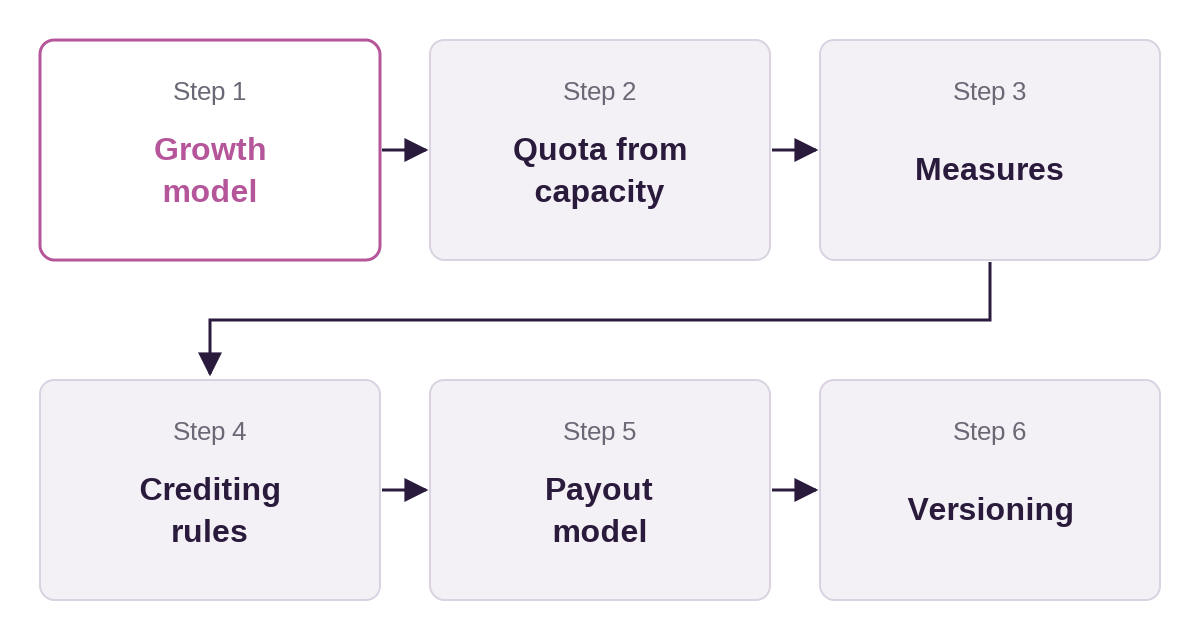
Design a commission plan in this order: growth model, quota from capacity, measures, crediting rules, payout model, versioning.
Step 1
Start from the growth model
Work out what each rep must close for the company to hit plan, by segment and by role. The commission plan exists to pay for those outcomes and nothing else.
Step 2
Set quota from capacity, not from the target
A quota that is the board number divided by headcount is a target, not a plan. Build it from ramped rep capacity and expected productivity, then reconcile it to the revenue plan. Our answer on quota setting from a capacity model sets out the method, and our pipeline and forecasting page covers the capacity model itself.
Step 3
Choose the fewest measures that pay for the right behavior
One or two measures per role. Every extra measure is a line a rep cannot calculate and a dispute waiting for month-end.
Step 4
Write the crediting rules before the rates
Who gets credit for a split deal, a partner-sourced deal, a multi-year contract, an expansion on a named account. If the rule cannot be expressed as fields in the CRM, rewrite it until it can.
Step 5
Model payouts before launch
Run the plan against last year's deals and a realistic attainment spread. Check the cost at plan, at low and at high attainment, and that the top performers are paid for what the company actually wanted.
Step 6
Version it
Store quotas, rates and territories with effective dates, so a mid-year change never rewrites the past (see the versioning section).
Worked example
A worked commission calculation (illustrative)
Commission is calculated by applying the plan’s rate to credited revenue for the period, with any accelerator applied only to the revenue above the threshold, and any clawback or draw recovery netted off before payout. Here is the formula a rep can rerun on their own deals, with round numbers.
Step
Formula
Base rate
Variable pay at OTE ÷ quota
Payout up to quota
Credited bookings × base rate
Payout above quota
(Quota × base rate) + ((credited bookings minus quota) × accelerated rate)
Net payout
Payout minus clawbacks minus any recoverable draw
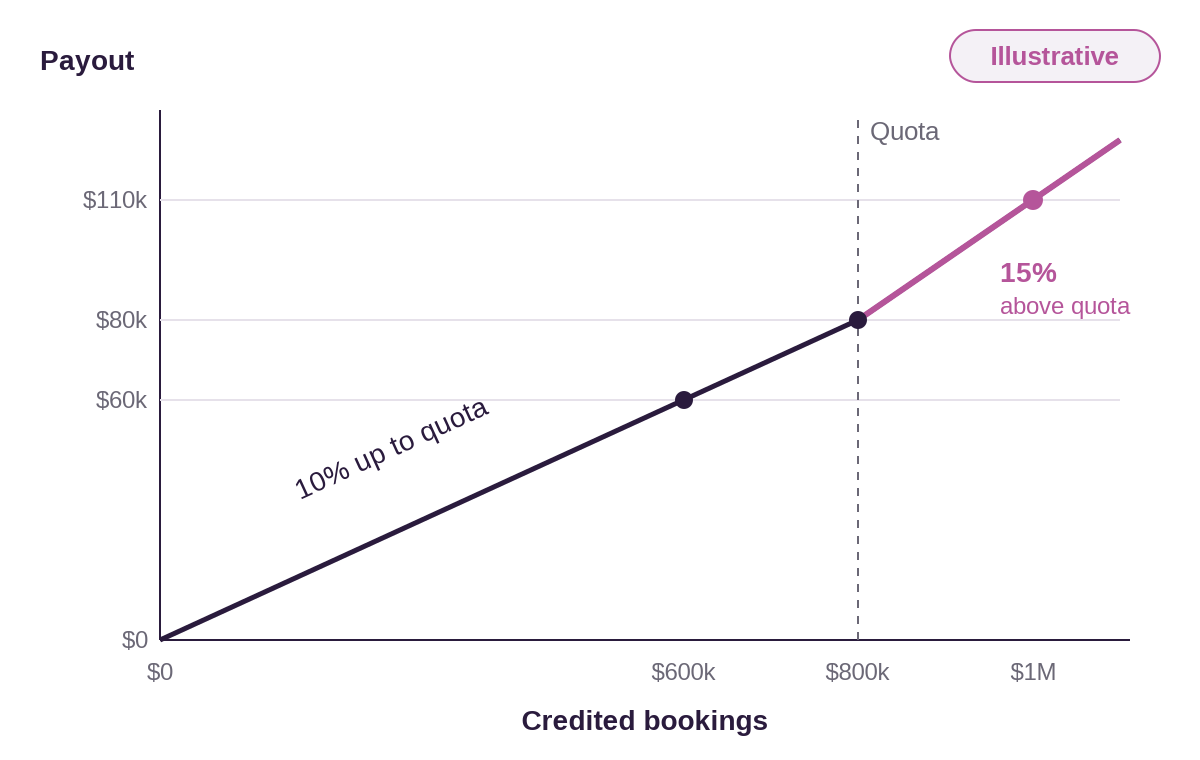
Illustrative example: an account executive has variable pay at OTE of $80,000 and an annual quota of $800,000 in new ARR. The base rate is $80,000 ÷ $800,000 = 10%. The plan pays 1.5 times the base rate above quota, so the accelerated rate is 15%.
One $50,000 deal cancels inside the clawback window
$50,000 × 10%
$5,000 recovered from the next payout
Illustrative payout against credited bookings: 10% to quota, 15% above it. Figures from the worked example, not a benchmark.
Run the same formulas across every rep and a realistic range of attainment and you have the cost of the plan, which is step 5 of the method above.
Versioning
Change the plan without rewriting history
Plans change. A territory moves, a product launches, a quota is cut halfway through the year. The change is rarely the problem; overwriting the old values is.
Most commission disputes are not about the plan. They are about the data.
01
Closed-won means different things to sales and finance
Sales marks a deal won at signature; finance may book it on a different date or amount. Under ASC 340-40 in the FASB Accounting Standards Codification, finance may also have to treat commissions as a cost of obtaining a contract, tied to a contract record. If the plan does not say which date and amount pay, both sides are right.
02
Crediting lives in a spreadsheet
Splits, overlays and partner deals get decided in email and typed into a sheet. The sheet becomes the system of record, and nobody can audit it.
03
The CRM cannot express the plan
The plan pays on new ARR, but the opportunity records total contract value with no ARR field. Someone recalculates by hand every month.
04
Changes overwrite history
A territory moves, a quota is cut mid-year, and the old values are gone. Nobody can reconstruct what a rep was owed under the plan they signed.
Each of these is a revenue operations problem, not a compensation design problem. Fix them and the plan can be calculated the same way by the rep, the manager, the commission tool and finance.
Start with a read-only review of your CRM, including the fields and definitions your commission plan depends on.
A clear definition of what counts. The definition matters more than the rate.
Account manager or customer success manager
Renewal, expansion or net retention
Often a separate plan from new business
Sales manager
Team attainment
Whether a player-coach carries a personal quota, decided explicitly
Working with us
Sales compensation consulting from the team that runs your RevOps
LeanScale does not sell compensation software and is not a comp benchmarking firm. We are an embedded GTM Ops team; commission work sits in our Revenue Operations practice because the problems that break commission plans live in the CRM: crediting, closed-won definitions, ARR fields, territories and versioned targets.
When a client’s commission plan is calculated in a spreadsheet and disputed every month, the work usually looks like this. Your leadership owns the plan; we make it calculable and keep it that way.
01
Model the plan
Against the growth model and quota capacity.
02
Write crediting rules
Rules the CRM can enforce, not decisions in email.
03
Build the fields
The fields and validation the plan depends on.
04
Connect the commission tool
If you run sales incentive compensation in a dedicated tool such as Spiff or CaptivateIQ, the CRM still has to send it clean, credited data. That integration is where we work.
05
Keep it running
Through the next plan change, with quotas, rates and territories versioned.
We work in Salesforce, HubSpot or your CRM of choice, on a 90-day rolling subscription with a dedicated pod, 4 to 12 week project cycles and uncapped ad hoc support on a same-day SLA. For ongoing ownership of the whole revenue system, see RevOps as a Service.
Customer proof
Teams we work with
LeanScale has partnered with 100+ growth-stage B2B SaaS companies, including Mistral AI, Chainguard, AssemblyAI, Clio, factory.ai, Anrok and Integrate.io. Rated 4.9 / 5 on G2. See our case studies.
Selected customers
Mistral AI
Chainguard
AssemblyAI
Clio
Fountain
RunPod
Factory.ai
Ocrolus
Anrok
Act-On
GreyNoise
Integrate.io
CallRail
Patlytics
SpyCloud
Scandit
Coactive
wealth.com
OpenArt
OnBoard
CUSTOMER REVIEW · G2
MANAGER, REVOPS
“They combine strategic RevOps thinking with hands-on execution, not just high-level recommendations. They help us actually design, document, and implement the systems we need.”
“LeanScale is an absolute partner in our go-to-market motion. They are experts when it comes to our technology stack as well as our business processes.”
A commission plan is the set of rules that decides a seller's variable pay: what revenue counts, at what rate, against what quota, and when it is paid. It is one part of the wider sales compensation plan, which also includes base salary, bonuses and SPIFs.
02
How should commission be calculated?
Apply the plan's rate to credited revenue for the period, apply any accelerator only to revenue above its threshold, and net off clawbacks or draw recovery before payout. The calculation is only as reliable as the crediting data in the CRM.
03
What are the three types of commissions?
Most plans are a flat rate on everything credited, a tiered rate that rises with attainment, or commission only with no base. In B2B SaaS, base plus a flat or tiered commission is the norm.
04
Can you give an example of a commission plan?
An account executive plan typically pays commission on new bookings against an annual or quarterly quota, at a rate equal to variable pay at OTE divided by quota, with a higher rate above 100% attainment and a clawback if the customer cancels early. Before launch, run it against last year's deals to check what it would have paid.
05
Do you provide a commission plan template?
No. A template copies someone else's rates and crediting rules. We start from your growth model and your CRM data instead, which is why the plan can then be calculated without a spreadsheet.
06
Does LeanScale offer sales compensation consulting?
Yes, as part of our Revenue Operations practice: modelling the plan, writing crediting rules the CRM can enforce, building the fields and integrations, and running it through plan changes. We do not sell compensation software.
Get started
Stop calculating commission in a spreadsheet
Start with the free GTM diagnostic: a read-only review of your CRM, including the fields and definitions your commission plan depends on.


 Mistral AI
 Chainguard
 AssemblyAI
 Clio
 Fountain
 RunPod
 Factory.ai
 Ocrolus
 Anrok
 Act-On
 GreyNoise
 Integrate.io
 CallRail
 Patlytics
 SpyCloud
 Scandit
 Coactive
 wealth.com
 OpenArt
 OnBoard