CRM migration services for B2B SaaS, from plan to the quarter after cutover
CRM migration services move your data, automation, integrations and reports from one CRM to another, most often HubSpot to Salesforce for a venture-backed SaaS company, without losing history or trust in the numbers. LeanScale designs the target CRM, runs the migration, reconciles the reports before cutover and then keeps operating the CRM with your team. Chainguard and Integrate.io each completed their move to Salesforce with us in 60 days.
A CRM migration is a rebuild, not a data copy. Most of the problems are decided before any data moves.
01
The old mess moves with the data
Duplicates, dead fields and broken stages copied into a new system that looks just as untrustworthy.
02
The import tool designs the data model
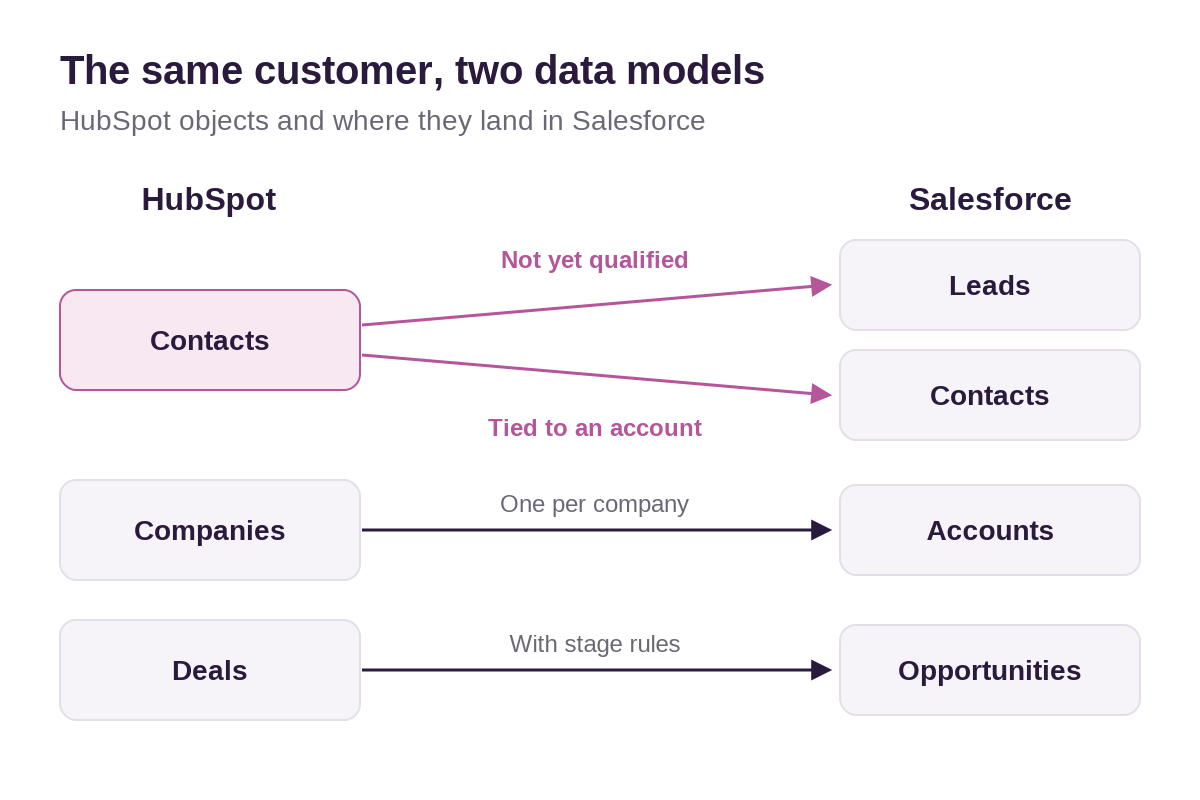
HubSpot and Salesforce model the same customer differently. Map field to field without deciding the target model, and reporting breaks on day one.
03
Automation and integrations come last
Workflows, routing, enrichment and billing connections all have to be rebuilt, tested and switched over in the right order.
04
Nobody owns the CRM after cutover
The project team leaves, reps hit their first problems, and adoption drops.
The decision
First, decide whether you should migrate at all
For a venture-backed SaaS company the trigger is usually a change in motion: a first enterprise segment, a sales-led motion replacing product-led growth, a Series B or C board asking for forecast discipline, or an acquisition that leaves you with two CRMs.
Sometimes moving is right; sometimes fixing the system you have is faster and cheaper. We work in Salesforce, HubSpot or your CRM of choice (our published migrations are both into Salesforce), and we will tell you which we see.
The free GTM Diagnostic is a read-only review of your current CRM, and the right first step either way.
An embedded LeanScale pod designs the target, moves the data, rebuilds what runs on top, trains your team and keeps running the CRM after go-live. The full method is in our CRM migration playbook; here is the short version.
01
Diagnose the source
A read-only review of the current CRM and what the business actually uses. We decide what moves, what is archived and what stays behind.
02
Design the target
The data model first, built for the motion you are moving into. Then the integration plan, with field ownership for every tool.
03
Map, clean and load
Fields mapped to the target model, duplicates resolved before the load, in dependency order. Every load runs on a sample first and is checked against the source.
04
Rebuild what runs on top
Routing, automation, sequences and connections, plus leadership's reports, checked against the old system before cutover.
05
Cut over and train
A planned cutover window, a freeze on the old system, and role-based training, so the first week is boring.
06
Run it
The pod stays, works the queue with a same-day SLA and fixes what real usage exposes. This is where most migrations quietly fail.
How long it takes. Our projects run in cycles of 4 to 12 weeks; Chainguard and Integrate.io each took 60 days. Yours depends on data volume, integrations and how much of the model changes.
Load order
What moves first: the load order
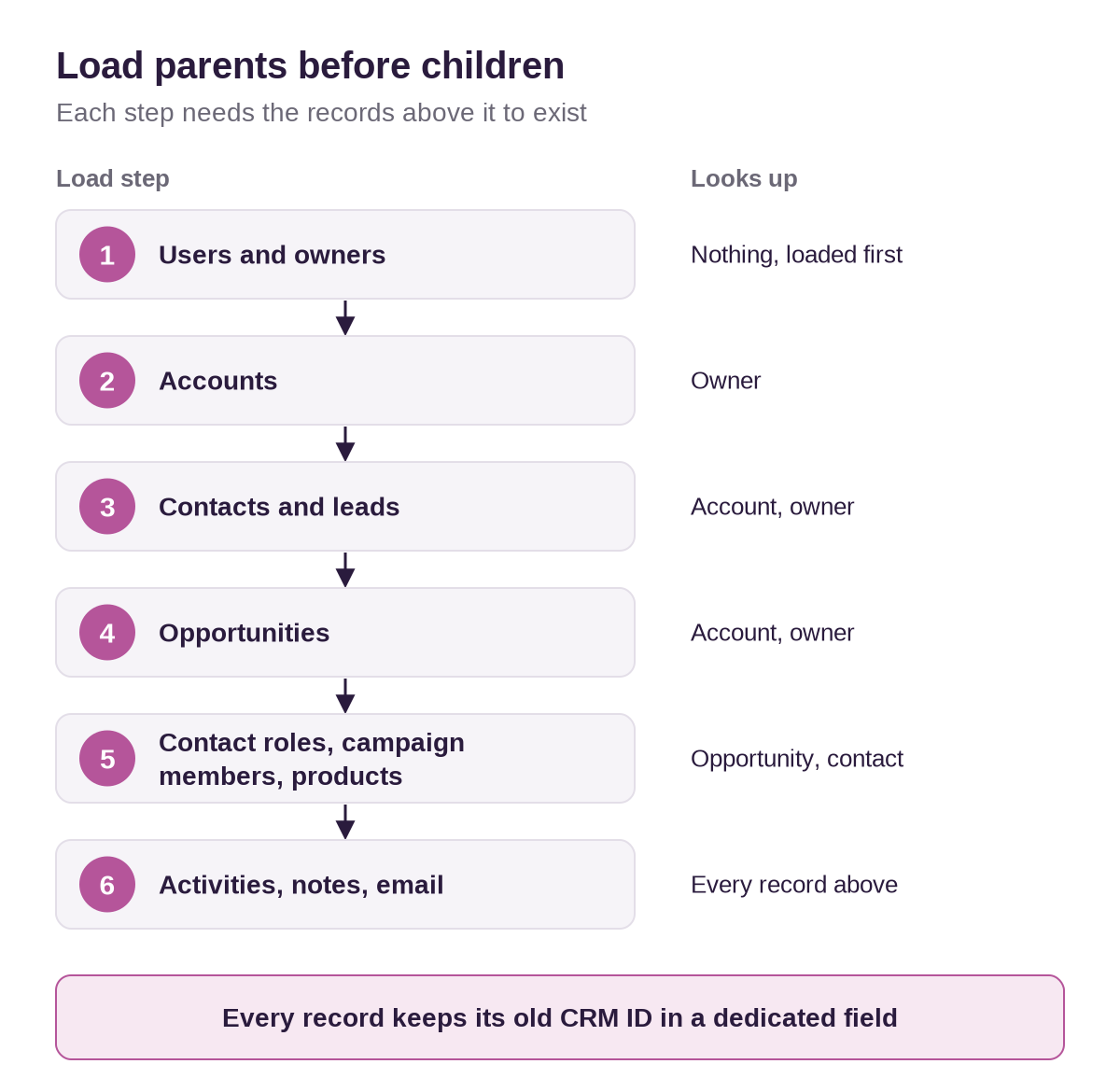
Records point at each other: a contact looks up its account, an opportunity its account and contacts, an activity all of them. Load a child before its parent and it arrives orphaned.
Our order: users and owners, accounts, contacts and leads, opportunities, then contact roles, campaign members and products, and last activities, notes and email history. Each record carries its old CRM ID in a dedicated field, so every relationship can be rebuilt and traced to the source.
Load parents before children, or the lookups have nothing to point to.
Reconciliation
Prove the numbers before you switch
A migration is done when leadership trusts the new CRM, not when the import log says zero errors.
HubSpot to Salesforce
HubSpot to Salesforce at Series B and C
A common move for venture-backed SaaS teams, usually when a sales-led or enterprise motion outgrows the portal. It has three traps.
01
The object model
HubSpot's contact-and-company model has to be redesigned into Salesforce leads, contacts, accounts and opportunities.
The same customer, modeled two ways. The target model is a decision, not an import setting.
As a HubSpot to Salesforce migration partner, we plan for all three. Comparing Salesforce migration services? Ask who will be running Salesforce after the move; with us, the same pod.
Doing it yourself? Start with our step-by-step answer on HubSpot to Salesforce migration. If you want it done, that is this page.
Your options
How to choose a CRM migration partner
Ask any partner the same five questions.
01
The data model
Who designs the target data model, and when?
02
Reconciliation
How do you reconcile records and reports against the old system before cutover?
03
Integrations
Which integrations do you rebuild, and who owns them afterwards?
04
References
Can I talk to a client who made the same move?
05
After go-live
What happens in the 90 days after go-live?
Several kinds of firm do this work well.
Salesforce side
Salesforce consultancies
Come from the Salesforce side.
HubSpot side
HubSpot partners
Such as New Breed and RevPartners. RevPartners lists a HubSpot CRM Data Migration accreditation; New Breed lists migration among its HubSpot RevOps offerings.
Data only
A data-migration vendor
Fits a pure data move with no redesign.
Motion change
LeanScale
When the migration is part of a change in go-to-market motion and you want the same operators running the CRM afterwards.
RevPartners and New Breed descriptions checked on each firm’s own site on 13 November 2026.
Customer proof
Migrations we have run
CASE STUDY · CHAINGUARD
HUBSPOT TO SALESFORCE IN 60 DAYS, SERIES B TO SERIES C
This team does it all, and they do it fast.
Jason Weinreb, Director of Sales Operations
3x
ARR growth through a sales-led motion
CASE STUDY · INTEGRATE.IO
CRM MIGRATION TO SALESFORCE
“LeanScale provided the playbook and technical expertise to get us up and running in 60 days. We were impressed by the speed, but even more impressed by how smooth and thorough the process was.”
Donal Tobin, CEO, Integrate.io
60 days
CRM migration to Salesforce
CUSTOMER REVIEW · G2
VP, GO-TO-MARKET OPERATIONS
“LeanScale is an absolute partner in our go-to-market motion. They are experts when it comes to our technology stack as well as our business processes.”
Which agencies handle HubSpot to Salesforce migration for SaaS companies?
Salesforce consultancies, HubSpot partners and RevOps agencies all do this work. LeanScale runs HubSpot to Salesforce migrations for venture-backed B2B SaaS teams with an embedded pod that stays after cutover. Chainguard moved from HubSpot to Salesforce with us in 60 days while scaling from Series B to Series C.
02
How long does a CRM migration take?
Our projects run in cycles of 4 to 12 weeks. Chainguard and Integrate.io each completed their migration to Salesforce in 60 days. Timelines depend on data volume, the number of integrations and how much the data model changes.
03
Can we keep HubSpot for marketing after moving sales to Salesforce?
Yes, and many teams do. HubSpot's Salesforce connector lets you set a sync rule per field ("Prefer Salesforce unless blank", "Always use Salesforce", "Two-way" or "Don't sync"). We choose one per field so campaign and source data reach Salesforce opportunities and both systems report on the same records.
04
How is LeanScale different from a CRM migration consultant or a migration tool?
A migration tool moves records. Salesforce's own guidance is to use the Data Import Wizard for simple loads under 50,000 records and Data Loader for larger loads or complex field mappings; third-party migration apps fill the gaps between CRMs. A consultant usually plans and hands over. We redesign the target CRM, choose and run the tools, rebuild what runs on top, train the team and then keep operating it, on a 90-day rolling subscription.
05
Can AI do the migration for us?
AI helps: it can draft field mappings, flag duplicates and check loaded records against the source, and we use bespoke AI agents built across hundreds of B2B SaaS deployments for exactly that. The decisions are still yours and ours: the target data model, which system owns which field, and what leadership's reports must show on day one.
06
What does a CRM migration cost?
It depends on data volume, integrations and the practices you need, so we scope it on a call. We do not publish a price. The commercial structure is a 90-day rolling subscription with no long-term contract.
Get started
Start with a read-only review of your current CRM
We will look at the system you have, tell you whether a migration is the right move, and if it is, give you a plan. Then you decide.


 Mistral AI
 Chainguard
 AssemblyAI
 Clio
 Fountain
 RunPod
 Factory.ai
 Ocrolus
 Anrok
 Act-On
 GreyNoise
 Integrate.io
 CallRail
 Patlytics
 SpyCloud
 Scandit
 Coactive
 wealth.com
 OpenArt
 OnBoard