LeanScale is a RevOps agency that works with fintech SaaS companies, including Anrok, Wealth.com and Ocrolus, as an embedded team inside their CRM. For Wealth.com we took DealHub CPQ from design to go-live in six weeks, with 100% team adoption and 60% faster quote turnaround. Fintech SaaS needs RevOps that keeps quotes on policy, reconciles the CRM with billing and close, and models the security reviews that slow deals down.
Rated 4.9 / 5 on G2. Fintech companies we work with include Anrok, Wealth.com and Ocrolus. Wealth.com figures from the published engagement.
Engagement
90-day rolling
Project cycle
4 to 12 weeks
Ad hoc support
Uncapped, same-day SLA
G2 rating
4.9 / 5
Powering startups backed by the biggest VCs in tech
Mistral AI
Chainguard
AssemblyAI
Clio
Factory.ai
Anrok
Integrate.io
The problem
Fintech SaaS sells to buyers who check the numbers
RevOps for fintech SaaS has a higher bar for accuracy than most B2B software. Your buyers are finance teams, advisors, lenders and operators who read contracts closely. Your own finance team reports to investors who will ask how bookings turned into revenue.
A fintech go to market strategy can be sound and still stall because quotes go out with the wrong terms, approvals live in Slack, and the CRM and the billing system disagree about what was sold.
01
If you are the CRO
Reps build quotes by hand, discounts get approved in direct messages, and nobody can say which deals went out off-policy. Deals slow down in security and procurement review, and the forecast does not show it.
02
If you run finance
Bookings in the CRM do not match what billing invoices. Revenue schedules are rebuilt in a spreadsheet every month. Collections chase customers whose contract terms nobody can find.
03
If you are the Head of RevOps
You own the CRM, the CPQ tool, the billing integration and the reporting, alone, and every pricing change lands on your desk.
Why it breaks here
Why GTM breaks earlier at fintech SaaS companies
Fintech startups hit four problems sooner than most B2B software companies.
01
Pricing needs governance early
Fintech products often price by volume, transactions, assets, entities or modules. Without approval rules and a quoting tool, every rep invents terms, and finance inherits them.
02
Revenue data has to be finance-grade
Bookings, billing and revenue schedules have to reconcile. A CRM that is good enough for pipeline reviews is not good enough for close.
03
Longer, review-heavy sales cycles
Security questionnaires, legal review and procurement add stages that a standard pipeline does not model, so forecasts look better than they are.
04
More than one buyer type
Many fintech SaaS companies sell to institutions, to professionals who serve clients, and sometimes to end users, each with its own funnel and routing.
Four practices
What we build for fintech SaaS, by practice
We run four GTM practices. Pick the one that is broken, or pick all four.
01
Revenue Operations
Quote-to-cash and configure, price, quote (CPQ) with approval rules that match your risk tolerance, deal stages that include security and procurement review, and pipeline and forecasting your CFO can read.
02
Marketing Operations
A lead lifecycle and routing for each buyer type, so institutional leads, professional users and self-serve signups reach the right team. B2B fintech marketing runs on the same lifecycle discipline as any SaaS company; what changes is the number of buyer types it has to handle.
03
Growth Operations
Enrichment and outbound systems built on Clay, targeted at the institutions and firms you sell to.
04
Financial Operations
Billing, revenue schedules, collections and close, reconciled with the CRM so sales and finance report the same number.
Quoting and approvals
Quote approvals and CPQ that keep every deal on policy
Fintech SaaS companies usually reach for CPQ software when the problem is still a process problem. We fix both, in that order.
01
Rules of engagement first
Who can offer what discount, on which terms, with whose approval. Agreed with sales and finance leadership before any tool is configured.
02
Approval flows at the right level of governance
Tight enough that off-policy deals cannot go out, loose enough that standard deals do not wait.
03
A tool chosen against your process
A vendor shortlist and a decision matrix, rather than whatever the last company used.
04
Ongoing changes
Pricing and packaging will change. Someone has to update the catalog, the rules and the templates each time.
Wealth.com builds estate planning technology for financial advisors, benefits departments and individuals. Heading into a hypergrowth phase, it was adding reps and contract volume quickly and had no defined rules of engagement or approval flows for quotes.
01
Interviews
We interviewed reps and leadership.
02
Process design
We designed several process flows at different levels of governance and risk tolerance, and agreed one with leadership.
03
Vendor choice
We evaluated CPQ vendors and gave leadership a decision matrix.
04
Build and support
We implemented DealHub integrated with Salesforce, and continue to support process and technical changes as pricing, packaging and products evolve.
Result
Wealth.com
Design to go-live
Six weeks, against a typical three to six months
Team adoption
100% of the new process and tools
Quote turnaround
60% faster
Policy
Every quote sent to customers complies with pricing and packaging guidelines
Like every project LeanScale has done for us, they did an incredible job getting our proposal and contracting process developed and completely streamlined with DealHub CPQ.
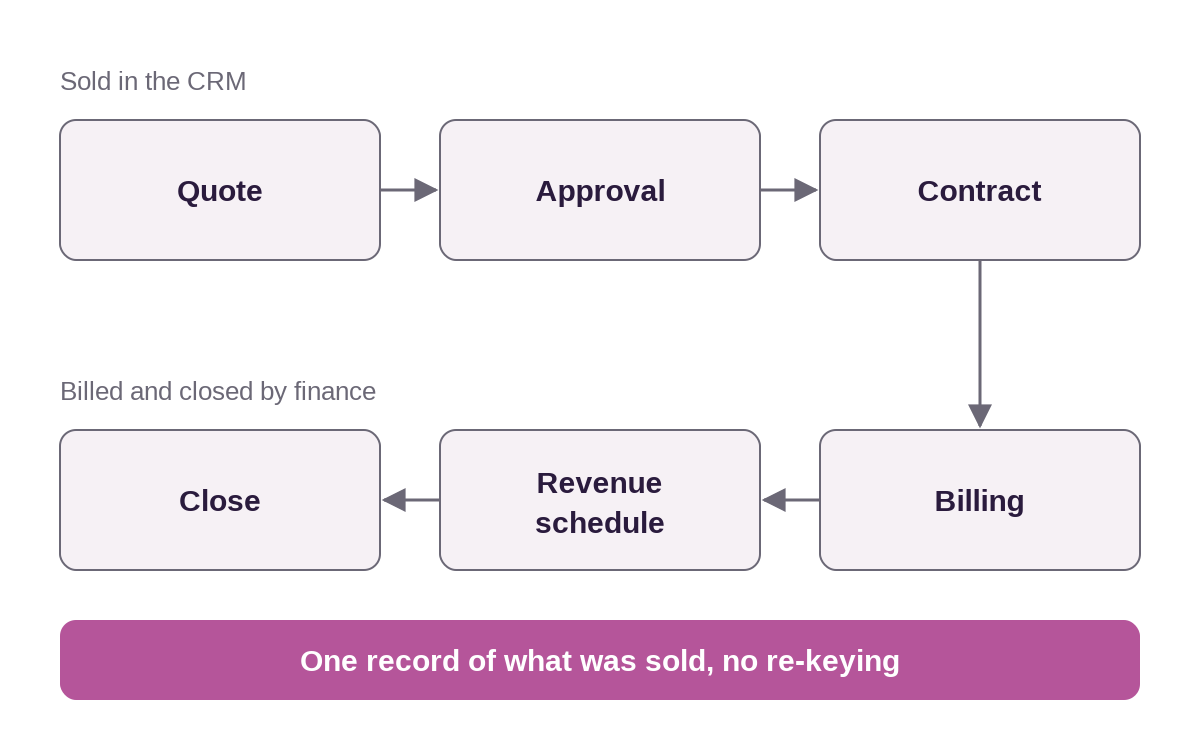
The CRM is where deals are sold; the billing system is where they are invoiced. In fintech SaaS the two have to agree, line by line, because your finance team and your investors will check.
01
One record of what was sold
The closed deal, the quote and the contract terms flow to billing without re-keying. See CRM to billing integration.
02
Revenue schedules built from the contract
Not rebuilt by hand at month-end. Under US GAAP, revenue recognition follows the contract and its performance obligations (FASB ASU 2014-09, Topic 606), so the contract data in the CRM has to be complete enough to build from.
03
Collections tied to the account
Account owners see overdue invoices before the renewal conversation, not after.
04
Close that does not wait on sales ops
Our Financial Operations practice owns billing, revenue schedules, collections and close, reconciled with the CRM.
Security and procurement review as pipeline stages
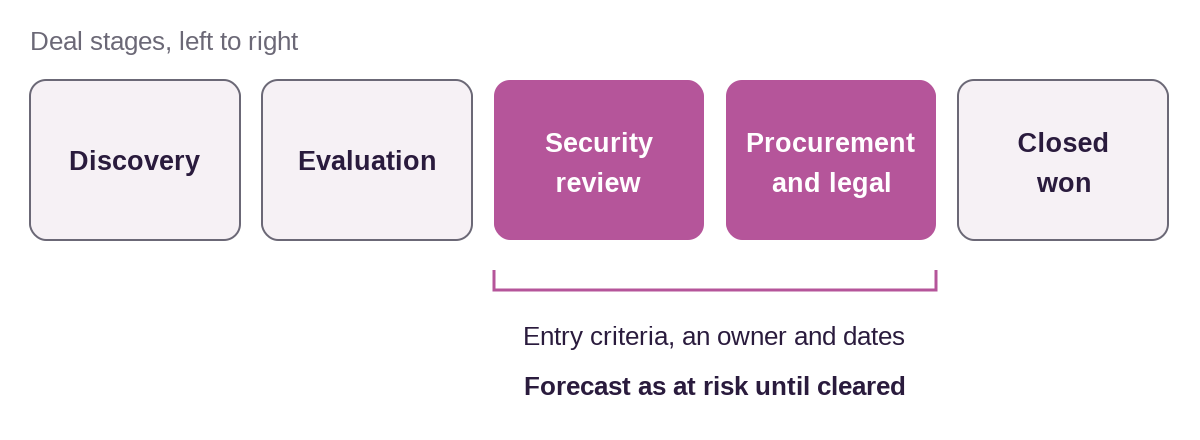
Fintech buyers rarely sign after the demo. A security questionnaire, a request for a SOC 2 report (an attestation built on the AICPA Trust Services Criteria), legal redlines and a procurement review follow.
In most CRMs none of that is a stage, so a deal waiting three weeks on a questionnaire still looks like it is about to close.
01
Review steps as stages
Stages or tracked milestones, with entry criteria and a named owner on your side (security, legal, finance).
02
Dates on each step
So you learn how long reviews take for each buyer type and plan the forecast around it.
03
A forecast category for blocked deals
Deals blocked on review show as at risk rather than late-stage and on track, so the CRO sees them.
Buyer types
Routing when you sell to institutions, professionals and end users
Many fintech SaaS companies sell to more than one kind of buyer: institutions such as banks and lenders, professionals who serve their own clients, and sometimes end users through self-serve. Each buys differently, and each needs its own path through the funnel.
01
Classify the buyer type at intake
From enrichment and the form, before any routing rule runs.
02
One path per buyer type
Each type gets its own lifecycle path and routing rules, so an institutional lead never waits in a self-serve queue.
03
Handle the overlaps
A professional user at a firm that is already an institutional customer belongs to the account owner, not the professional team.
The routing mechanics (models, response windows, tools) are on our lead routing page.
Scope
What we do and do not do for fintech companies
We do
Design, build and run GTM systems
CRM, CPQ, routing, reporting, billing integration and close processes.
We do not
Advise on compliance
We do not give legal, tax or regulatory compliance advice, and we do not replace your compliance or security team.
Choosing an agency
What fintech startups should ask a RevOps agency
If you are comparing RevOps agencies for fintech startups, ask the general questions (who does the work, in which CRM, on what terms), then four specific to fintech.
01
Have you built quote approval rules and CPQ for a company like ours?
And how long did it take?
02
Who reconciles the CRM with billing?
And do you own close, or hand that back to finance?
03
How do you model security and procurement review?
In the pipeline, with stages and dates.
04
Will you stay for the next pricing change?
Every pricing change touches the catalog, the rules and the templates.
Our answers are on this page. For a comparison of RevOps firms on delivery model, CRM focus and terms, see our RevOps agency comparison.
Engagement model
How we work with fintech SaaS companies
01
Start with a diagnostic
A GTM Diagnostic is a read-only review of your CRM across the four practices, with a ranked list of fixes.
02
A dedicated pod, inside your systems
We work in Salesforce, HubSpot or the CRM you already use. For Salesforce for fintech teams, that includes CPQ, approvals and the billing integration; see Salesforce RevOps.
03
A subscription, not a project
90-day rolling. Projects run on 4 to 12 week cycles, and ad hoc support is uncapped with a same-day SLA.
Questions fintech SaaS companies ask before they start
01
What does RevOps for a fintech SaaS company cover?
Revenue, marketing, growth and financial operations, with more weight than usual on three areas: quote approvals and CPQ, CRM data that reconciles with billing, and a pipeline that models security and procurement review. We run them as one embedded team inside your CRM, on a 90-day rolling subscription.
02
Which RevOps agencies work with fintech startups?
LeanScale does. We work with fintech SaaS companies including Anrok, Wealth.com and Ocrolus, as an embedded team inside their CRM. For Wealth.com we took DealHub CPQ from design to go-live in six weeks, with 100% team adoption and 60% faster quote turnaround.
03
Can you reconcile our CRM with our billing system?
Yes. Our Financial Operations practice owns billing, revenue schedules, collections and close, reconciled with the CRM, so sales and finance report the same number.
04
Do you provide compliance or regulatory advice?
No. We build GTM systems, not compliance programs. Where your obligations affect the CRM or quoting (field access, contract storage, approval trails), we build to the requirements your compliance and security owners set.
05
Do you work in Salesforce or HubSpot?
Both, or the CRM you already use. We work inside your instance, so you own every rule and report we build.
06
How long is the commitment?
A 90-day rolling subscription. Projects run on 4 to 12 week cycles, and ad hoc support is uncapped with a same-day SLA.
Customer proof
Trusted by fintech SaaS companies and growth-stage B2B SaaS
“LeanScale is an absolute partner in our go-to-market motion. They are experts when it comes to our technology stack as well as our business processes.”
“LeanScale provided the playbook and technical expertise to get us up and running in 60 days. We were impressed by the speed, but even more impressed by how smooth and thorough the process was.”
Donal Tobin
100+
Growth-stage B2B SaaS partnerships
Get started
See where your quotes, pipeline and billing disagree
A GTM Diagnostic reads your CRM and the joins to quoting and billing, and tells you what to fix first. Then you decide whether you want us to build it.


 Mistral AI
 Chainguard
 AssemblyAI
 Clio
 Factory.ai
 Anrok
 Integrate.io