LeanScale is a RevOps agency that works with AI companies, including Mistral AI, AssemblyAI, factory.ai and Runpod, as an embedded team inside their CRM. For AI startups, RevOps has to handle three things classic SaaS playbooks skip: usage-based revenue in the CRM, self-serve and sales-led motions in one funnel, and capacity plans for a sales team that is hiring fast. We cover all three, plus billing and close, on a 90-day rolling subscription.
Rated 4.9 / 5 on G2. AI companies we work with include Mistral AI, AssemblyAI, factory.ai and Runpod.
Engagement
90-day rolling
Project cycle
4 to 12 weeks
Ad hoc support
Uncapped, same-day SLA
G2 rating
4.9 / 5
Powering startups backed by the biggest VCs in tech
Mistral AI
Chainguard
AssemblyAI
Clio
Factory.ai
Anrok
Integrate.io
The problem
AI companies outgrow their GTM systems in quarters, not years
RevOps for AI companies starts from a different place than classic SaaS. The product is often bought by usage before anyone signs a contract, and pricing changes as model costs change.
A developer signs up on a credit card on Monday and their employer asks for a security review and an enterprise agreement by Friday. Headcount plans get rewritten every time a round closes.
A CRM set up for seat-based annual contracts was not built for any of that. The AI GTM strategy you present to the board is only as good as the data under it.
01
If you are the CRO
Your forecast has two halves that do not talk to each other: contracted deals in the CRM and usage that lives in the product and billing data. Reps see a self-serve account only after it has outgrown its plan. Territories and quotas were set for a team half the size you will have next quarter.
02
If you run finance
The revenue you report and the revenue in the CRM disagree, because usage, credits, overages and true-ups are billed in one system and sold in another. Every month-end needs a spreadsheet to reconcile them.
03
If you are the Head of RevOps
You are the only person who understands how product, billing and CRM data connect, and you spend your week patching the joins instead of building what the next stage needs.
Why it breaks here
Why GTM breaks earlier at AI companies
Three things make AI startups different from the SaaS companies most RevOps playbooks were written for. Our answer on how AI-native companies run GTM differently goes further.
01
Usage-based revenue
Consumption, credits and commitment plus overage do not fit an opportunity with a fixed amount and a close date. If the CRM cannot hold them, forecasting and commission plans drift away from what customers actually pay.
02
Self-serve and sales-led at the same time
Many AI companies sell to developers through the product and to enterprises through a sales team. The handoff between the two is where accounts get lost or double-worked.
03
Hiring at speed
Sales teams double between rounds. Every new rep needs a territory, a quota, routing rules and a ramp plan, and the plan changes every time the board does.
Four practices
What we build for AI companies, by practice
We run four GTM practices. AI companies usually start with one and add others as they grow. Pick the one that is broken, or pick all four.
01
Revenue Operations
A CRM data model that holds contracted and usage revenue side by side, pipeline and forecasting that separate committed from expected, territories and capacity plans for a team that is growing fast, and quote-to-cash for commitment plus overage deals. See pipeline and forecasting.
02
Marketing Operations
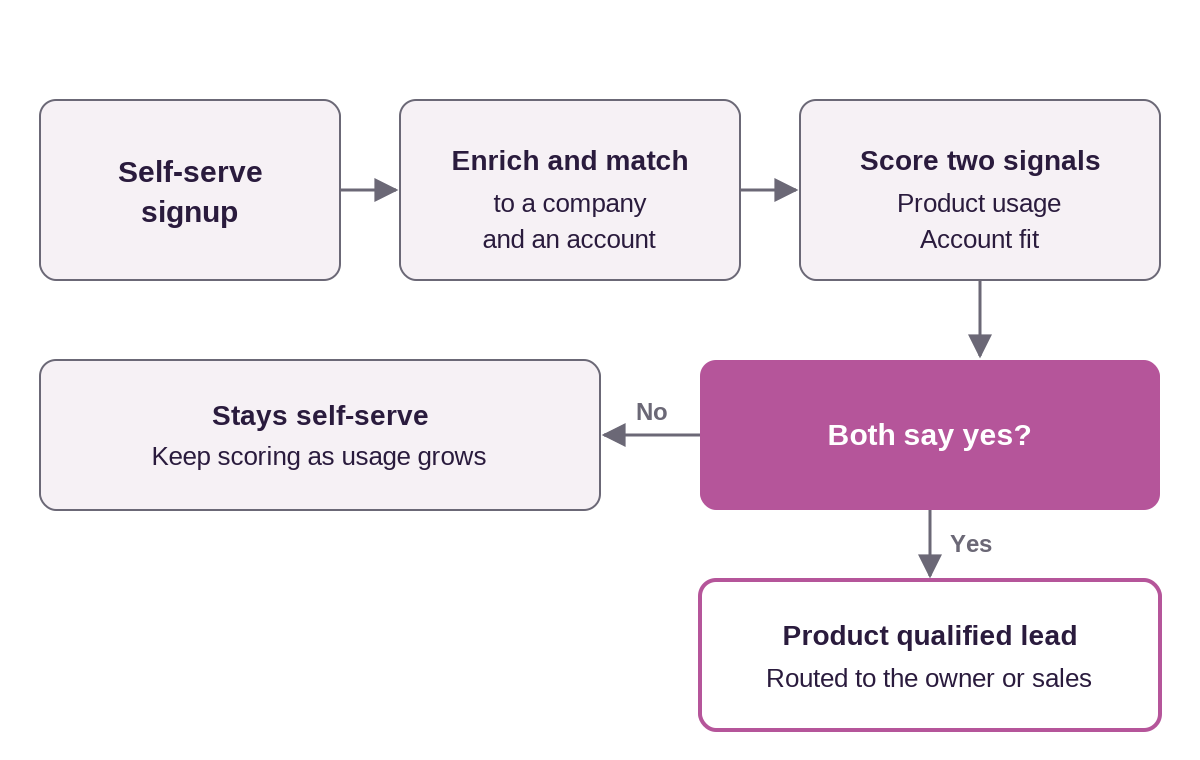
A lifecycle that includes product signups, scoring that blends product usage with firmographic fit, and routing that sends a self-serve account to sales at the right moment. See lead lifecycle and lead routing.
03
Growth Operations
Enrichment of developer signups so you know which company they work for, and outbound and inbound systems built on Clay. LeanScale has been a Clay Studio Partner since 2024, one of the early Studio Partners.
04
Financial Operations
Billing, revenue schedules, collections and close, reconciled with the CRM so finance and sales report the same number.
05
Across all four
Delivery is backed by bespoke AI agents and playbooks built across hundreds of B2B SaaS deployments. We are an AI-native team, which matters when your buyers and your board expect your own GTM to use the tools you sell.
Usage-based revenue
Usage-based pricing in a CRM built for contracts
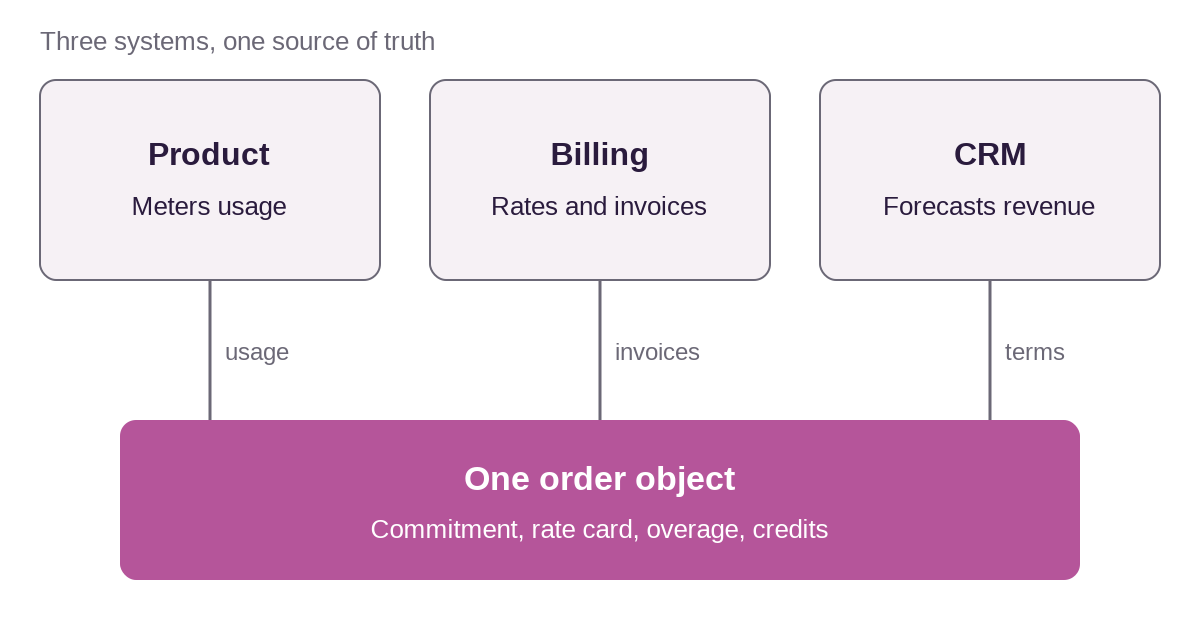
Usage based pricing and consumption based pricing change what the CRM has to know. A seat contract has an amount and a term. A usage contract has a commitment, a rate card, overage terms, maybe a credit pool, and revenue that only exists once the customer consumes it.
Usage based pricing in SaaS breaks the assumption most CRMs are built on: that the deal amount is the revenue. What we set up:
01
One order object as the source of truth
The order sales closes is the order finance bills. No re-keying between configure, price, quote (CPQ) tools, the CRM and billing.
02
Committed and expected revenue as separate fields
Forecast the commitment with confidence; forecast usage on top of it as an estimate, with the method written down.
03
Usage data flowing back to the account
Account owners and customer success see consumption trends before the invoice does, so expansion and churn risk show up early.
04
Commission data that matches how revenue arrives
If reps are paid on commitment and the company is paid on consumption, the plan has to say what happens when the two diverge, and the CRM has to hold the data to calculate it.
Product led sales: one funnel for self-serve and sales-led
Most AI companies run two motions at once. The work is making them one funnel.
PQL
Product qualified leads
A product qualified lead (PQL) is a self-serve user or account whose product usage says a sales conversation is worth having: team size, usage growth, a feature only larger customers use, a company domain that matches a target account. Define it with sales, score it, and route it like any other qualified lead.
Handoff
Rules of engagement
Decide when a self-serve account becomes a sales account, who owns it, and what happens to the self-serve plan when sales steps in. Write it down before reps find out the hard way.
One customer, three names: joining product, CRM and billing data
A developer signs up with a personal email. Their team uses a work domain. Billing sits under the legal entity’s name.
Until those three records resolve to one account, nobody can see that the account is growing, sales calls a customer as a prospect, and expansion revenue shows up as new business. What we set up:
01
A matching key per system
Work domain for the CRM, workspace or organization ID for the product, customer ID for billing, with a mapping table that links them.
02
Rules for personal emails
Match on the workspace the user joins, not the email they signed up with.
03
A review queue
For records that match more than one account or none.
04
One account record
One account record that sales, customer success and finance all read.
Capacity planning when the sales team doubles at AI companies
AI companies hire ahead of the plan. Capacity planning tells you whether the plan holds: how many reps, when they start, how long they take to ramp, and how much pipeline they need.
AssemblyAI, a speech recognition and transcription company, needed a sales capacity plan for its 2023 corporate plan, covering marketing, sales, customer success, partnerships and product. We built it in 4 weeks; the case notes that models like this typically take 2 to 3 months.
Data
Funnel data ready on day one
LeanScale already built and managed AssemblyAI's Salesforce instance (migrated from Zoho), so the plan started from data the team trusted.
Scenarios
Assumptions the team could change
AssemblyAI's team could change reps, hire dates, attrition and conversion assumptions and see the result immediately, with Bull, Bear and Expected scenarios reviewed with executive leadership.
LeanScale was able to build a plan we could trust with accurate data from the Salesforce instance they built and manage.
If you are comparing RevOps agencies for an AI startup, the general questions apply (who does the work, in which CRM, on what terms). Add four that are specific to AI companies.
01
Can you model usage-based revenue in our CRM?
Not only seat contracts.
02
Have you connected product data to the CRM?
So sales sees self-serve accounts as they grow.
03
Can you plan capacity for a team that is hiring every month?
And update the plan when the round closes.
04
Will you stay after the build?
Pricing and packaging at AI companies change often. Every change touches CPQ, billing and reporting.
Our answers are on this page. For a comparison of RevOps firms on delivery model, CRM focus and terms, see our RevOps agency comparison.
Engagement model
How we work with AI companies
01
Start with a diagnostic
A GTM Diagnostic is a read-only review of your CRM across the four practices. It returns a ranked list of what is broken and which practice owns each fix.
02
A dedicated pod, inside your systems
Operators from the relevant practice work in your Salesforce, HubSpot or other CRM, with your team, on your backlog. You keep strategy, targets and headcount decisions. If you already have a RevOps lead, we work alongside them.
03
A subscription, not a project
90-day rolling. Projects run on 4 to 12 week cycles, and ad hoc support is uncapped with a same-day SLA. That suits AI companies, where the next pricing change is usually already on the roadmap.
The same four areas as any B2B SaaS company (revenue, marketing, growth and financial operations), plus three that AI companies hit early: holding usage-based revenue in the CRM, joining self-serve and sales-led into one funnel, and planning capacity for a sales team that is hiring fast. We cover all of it as one embedded team inside your CRM, on a 90-day rolling subscription.
02
Which RevOps agencies work with AI startups?
LeanScale does. We work with AI companies including Mistral AI, AssemblyAI, factory.ai and Runpod, as an embedded team inside their CRM. When comparing agencies, ask whether they can model usage-based revenue, connect product data to the CRM and stay on after the build.
03
Can you handle usage-based or consumption pricing in Salesforce or HubSpot?
Yes. We set up one order object that sales and finance share, keep committed and expected revenue in separate fields, and bring usage data back to the account. Billing, revenue schedules and close sit with our Financial Operations practice.
04
What is a product qualified lead?
A user or account whose product usage shows a sales conversation is worth having, such as team growth, usage growth or a feature larger customers use. It is defined by product behaviour, not by a form fill.
05
Do you use AI in your own delivery?
Yes. LeanScale is an AI-native GTM agency. Delivery is backed by bespoke AI agents and playbooks built across hundreds of B2B SaaS deployments.
06
How long is the commitment?
A 90-day rolling subscription. Projects run on 4 to 12 week cycles, and ad hoc support is uncapped with a same-day SLA. There is no multi-year contract.
“They operate as true thought partners, with a strong point of view on AI-driven RevOps and a clear understanding of how to optimize within complex tech stacks.”
“They combine strategic RevOps thinking with hands-on execution, not just high-level recommendations. They help us actually design, document, and implement the systems we need.”
Nicholas B., via G2
100+
Growth-stage B2B SaaS partnerships
Get started
Find out what will break before your next round does
A GTM Diagnostic reads your CRM, your funnel and the joins to product and billing, and tells you what to fix first. Then you decide whether you want us to build it.


 Mistral AI
 Chainguard
 AssemblyAI
 Clio
 Factory.ai
 Anrok
 Integrate.io